Chamaeleo (Trioceros) bitaeniatus
Scientific name Common name(s) alternate scientific names described by year size brood

Chamaeleo (Trioceros) bitaeniatus

Two-lined or Side-striped Chameleon Chamaeleo bivittatus, Chamaeleon bitaeniatus
see a species list of Chamaeleo
Fischer 1884 Small Live

This small (total length 6 inches) chameleon is only moderately aggressive toward conspecifics and timid toward keepers. 

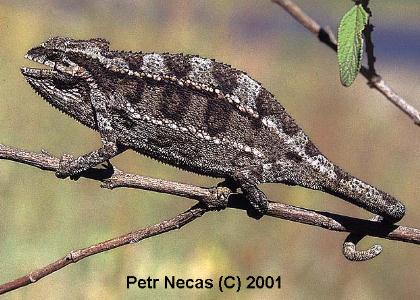
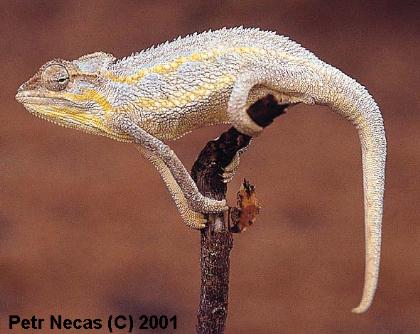
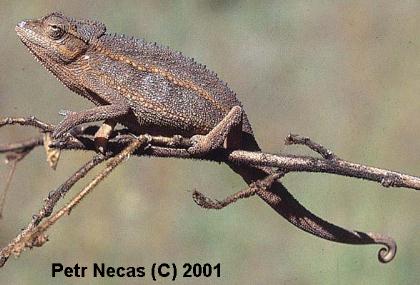
Identification: A small chameleon with both sexes reaching about 6 inches total length. Sexing is difficult as the hemipenal bulge of the males is not obvious. They appear to have a thicker, perhaps shorter tail than the females. C. bitaeniatus has a low casque lacking occipital lobes. Enlarged, granular scales adorn the rostral ridges of the head ( canthi rostralis). Despite what its inclusion in the subgenus Triocerus (i.e., 3 horns) might imply, rostral processes are absent. Squamation is relatively heterogeneous. Small, light colored gular, dorsal and ventral crests are composed of conical scales. Two rows of light colored, enlarged, plate-like or lens-shaped (i.e., lenticular) scales run down the flanks and give the species its name, bitaeniatus (i.e., two-lined). .The top stripe starts behind the eye turret and runs into the tail. The bottom stripe starts on the neck and runs to the pelvis. These stripes are primarily white but can change color according to mood. Colors are particularly variable due to the wide distribution of the species but are primarily a dull gray or brown on white.

Distribution: Ethiopia , Kenya , Somalia , Tanzania , Uganda , southern Sudan and northeast DR. Congo . C. bitaeniatus prefers humid regions up to 3,000 m elevation where it inhabits bushes and trees. 

Captive Care: C. bitaeniatus is an extremely sedentary species. Males will sit for several days in the same spot. Females are a little more active over the course of a day, moving to a basking area to warm up then moving back to the shade to eat and rest. Screen cages  large cage is not necessary but must be large enough to provide a steep thermal gradient. Basking spot temperatures should be 80° F with an ambient temperature in the low 70’s. Cool to cold room temperatures at night are well tolerated. Humidity should be 80% or higher. Higher temperatures combined with low humidity are lethal to this species. Most crunchy commercially available insects are accepted. These include meal worms, superworms (Zophobus morio), and crickets,  Their appetites match their activity levels and they need not be fed daily.  Always keep chameleons in individual cages. Gravid females are particularly intolerant and aggressive to cage mates. In the wild, C. bitaeniatus is often found in dense populations. This fact, combined with the unassuming demeanor of the species, has led some keepers to maintain C. bitaeniatus in pairs. While pairs may be kept together in an appropriately sized cage, housing two animals together is not recommended for the new or average keeper who may not be able to sense the subtle signs of stress that co-habitation often brings.

 Breeding: There is a marked wet season in November and again in March to May that should be simulated in captivity to stimulate breeding. Females take on a lighter color and become slightly more active when they are receptive. These differences are extremely subtle and may be missed by most keepers. C. bitaeniatus may have two broods/year. When receptive, the female should be introduced to the male's cage. Copulation lasts for 10 to 20 minutes and may occur several times a day during the few days of the female's receptivity. Females will become aggressive to the males once gravid and should be separated immediately. Within a few weeks of mating the females take on a heavy, gravid look. Babies are born live after a gestation of approximately 6 months. Litter sizes range from 3 to 25 individuals but average 12. Neonates are approximately 2 inches total length when born and look like miniature adults. Individual cages are recommended to allow for better monitoring of the health and appetites of individual babies and juveniles. Fed on properly gut-loaded pinhead crickets and fruit flies, sexual maturity will occur by 6  months of age. See the Adcham.com article on Baby Care for more suggestions on the cage, feeding, hydration, and general care of baby chameleons.

Contributed by Tracey Cress and Ed Pollak

References 

Klaver, C. & W. Boehme. 1997. Chamaeleonidae. Das Tierreich, 112: i-xiv' 1 - 85. Verlag Walter de Gruyter & Co., Berlin, New York. 

Martin, J., 1992. Masters of Disguise: A Natural History of Chameleons. Facts On File, Inc., New York, NY.

Necas, P. 2002. Chameleons of the Subgenus Trioceros. Reptilia, October. 

Necas, P. 2004. Chameleons: Nature's Hidden Jewels. Chimera,2nd edition. Frankfurt.

Spawls, S., Howell, K., Drewes, R., and Ashe, J. 2002. A Field Guide to the Reptiles of East Africa. Academic Press, New York.

click on any thumbnail for a larger image
This page last modified on: Sunday, February 22, 2009

Copyright 2002-2009 ADCHAM.com
ADCHAM logo illustrated by Randy Douglas. Web site design by Look Design, Inc.
Do not reproduce or redistibute any of content of this web site without express written permission from the authors.