Taxonomic
status: Furcifer
lateralis major has been
suggested to be a separate
species, F. major,
but that status has not been
formalized and Klaver and
Boehme (1997) consider it to
be a subspecies of F.
lateralis.
The
original specimens of F. major
may, in fact, have been only
some unusually large
specimens of F. lateralis
males (approximately 12
inches) from western
Madagascar
(Henkel
and Schmidt, 1995).
In contrast, most specimens
of F. lateralis lateralis
males
from more southern regions reach
lengths of only 8 inches.
Females tend to me slightly
smaller in both populations.
Identification:
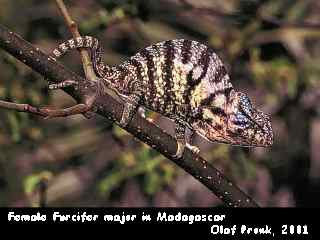
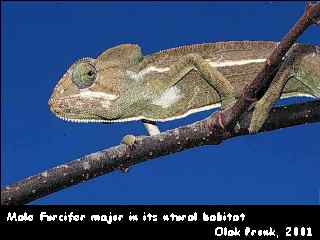
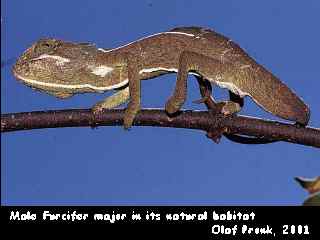
Coloration is primarily
bright green and both sexes
are characterized by a white
ventral line with three or
four dark circles on the
flanks. The eye turrets are
flecked with turquoise
colored scales. Males are
easily identified by their
enlarged hemipenal bulge.
The females are more
colorful than the males,
particularly during
gestation. The head bears a
low casque with no occipital
lobes. A small crest of
conical scales is present on
the throat, underside and
dorsum. There are no horns
or other rostral appendages.
Squamation is homogenous.
Distribution:
F.
lateralis major
is found in the
southwestern coastal areas
of
Madagascar
.
Captive Care: The
majors are very shy and do
well in densely planted
terraria. Due to the
reserved nature of these
animals, handling is not
recommended. Both sexes are
territorial and should be
housed separately. Males are
very active, patrolling
their territories and should
be provided a large cage for
their wellbeing (i.e.
20”x20”x36” or
larger). The females are a
little more calm and can be
kept in something slightly
smaller (i.e.:
18”x18”x30”), but
still large enough to
provide a proper temperature
gradient. Basking spot
temperatures should be 80º-85ºF
with ambient temperatures
into the 70’s. Cooler room
temperatures are well
tolerated at night and no
supplemental heating is
needed. High humidity is
crucial for the species and
should not drop any lower
than 80%. 90-100% is
recommended. A proper egg
laying container should be
provided for the females as
they will produce eggs
whether bred or not.
Breeding:
Properly kept females will
cycle upwards of six times a
year. Receptivity is marked
by a pronounced bright
yellow background colour
with pink eye turrets and
lips along with blue flecks
on the cheeks and flanks.
Females remain receptive for
3 or 4 days and should be
introduced to the males’
enclosure for mating.
Supervision is recommended
during these times in case
of excessive aggression from
either party. Copulation
lasts 10 to 20 minutes and
can be attempted many times
a day. Once a female is
gravid, she becomes
aggressive and stressed in
the presence of the male and
should be returned to her
own cage. Gravid females
sport bright pinks, greens
and blues on a black
background. The time from
copulation to laying is
typically 30-40 days. On
average 10 to 20 eggs are
deposited in a shallow hole
dug by the female. Female
will become receptive once
again approximately 20 days
after laying. Sperm
retention has been noted and
clutches produced from
retained sperm is not
uncommon.
Incubation:
Fertilized eggs should be
kept between 65º and 70º F
for the first six weeks.
After this point a slight
drop in temperatures (into
the lower 60’s) for
another six to eight weeks
will simulate diapause.
After that, temperatures may
be very slowly brought up to
68º-75º F. Total
incubation times average
nine months.
Hatchlings are about two
inches total length. They
sport a gray color but turn
to the adult green at about
six months of age.
Hatchlings are very hardy
and accept most commercially
available feeder insects
once their yolk sacs are
fully absorbed. Babies can
be raised in groups but
individual rearing is
recommended to monitor
individual growth and
appetites. Males are easily
sexed right out of the egg
by the hemipenal bulge but
this difference isn’t as
apparent after the first
week. Sexing, once again,
becomes easy after about 6
weeks of age. Sexual
maturity occurs at about six
months of age.
Contributed
by Tracey Cress
Glaw,
F. & M. Vences.
2007. A Field Guide to
the Amphibians and
Reptiles of
Madagascar
. 3rd Edition.
Chimaerira,
Köln.
Henkel,
F. W., and Schmidt, W.
1995. Amphibians and
Reptiles of
Madagascar
and the Mascarene,
Seychelles
and
Comoro
Islands
. Kriege. 1995
Klaver, C. & W. Boehme.
1997. Chamaeleonidae. Das Tierreich, 112: i-xiv' 1 - 85. Verlag Walter de Gruyter & Co., Berlin, New York.
Necas,
P. 2004, Chameleons:
Nature’s Hidden
Jewels. Chimera. 2004